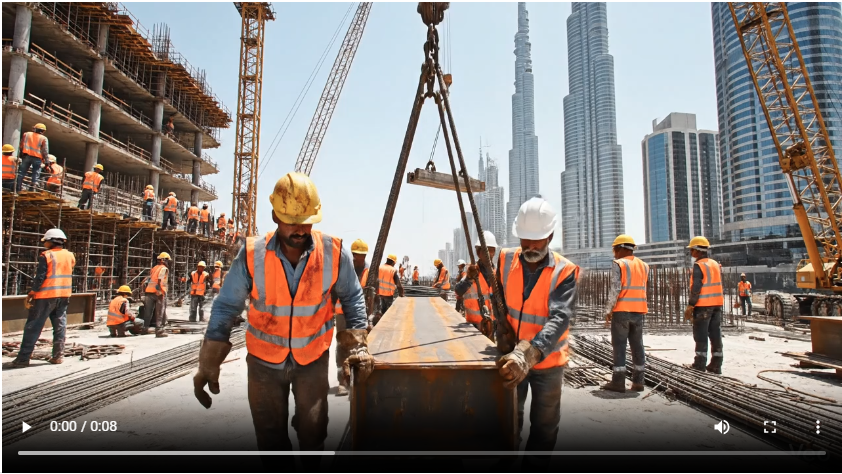
Dubai, UAE — 11:47 PM
The temperature has finally dropped below 35°C when Rajesh Kumar steps off the construction shuttle at the Al Quoz labor camp. His shift started at 6 AM—seventeen hours ago. His hands are cracked from handling steel reinforcement bars, and his safety helmet has left a permanent dent in his hair. But tonight, as he walks past the rows of identical porta-cabins, he doesn’t feel the exhaustion. He feels the weight of ₹4.2 lakh sitting in his bank account back home in Kerala.
That’s approximately $5,000 USD, or AED 18,400—enough to cover the first year of his daughter Anjali’s medical school tuition.
“I missed her 18th birthday last month,” Rajesh says, washing his face at the communal sink. “But I sent the money for her NRI quota seat. That’s better than any gift.”
The Mathematics of Hope
Rajesh, 47, has worked in Dubai’s construction sector for 14 years. His monthly salary of AED 1,800 (approximately ₹44,000 or $490) places him in the lower income bracket of UAE’s 9-million-strong expatriate workforce. After accommodation deductions (AED 300), food expenses (AED 400), and remittance fees, he typically sends home AED 900-1,000 monthly—about ₹22,000-24,000.
At current exchange rates (1 AED = ₹24.65 as of late 2024) , that’s roughly $1,100-1,200 per month.
The math is brutal but precise:
- Monthly remittance: AED 1,000 (₹24,650)
- Annual savings target: ₹4,00,000 (approximately $4,850)
- Years required to fund 5-year MBBS: 5+ years of disciplined saving
Medical education in India through the NRI quota—available to children of overseas workers—costs between ₹20-25 lakh per year at government medical colleges, and up to ₹40-45 lakh at private institutions . For a five-year MBBS program, Rajesh is looking at a total investment of ₹1.25-2 crore ($150,000-240,000).
“I don’t drink. I don’t smoke. I don’t go to the malls,” Rajesh explains. “Every dirham I save is a brick in my daughter’s hospital.”
The Kerala Connection: A Migration Economy
Rajesh’s story is not unique—it is statistically inevitable. Kerala, India’s southernmost state, has built its modern economy on the backs of workers like him.
According to the Kerala Migration Survey 2023, the state has 2.73 million non-resident Keralites (NRKs), with 80.5% working in Gulf Cooperation Council (GCC) countries . The UAE alone hosts approximately 3.5 million Indian workers, with Kerala representing a significant portion .
The economic impact is staggering:
- Total remittances to Kerala (2023): ₹2,16,893 crore ($26.2 billion USD)
- Share of Kerala’s Net State Domestic Product: 23.2%
- Households receiving monthly remittances: 73.3%
- Average remittance per household: ₹2,23,729 annually
“Kerala has the highest wage rates among Indian states,” notes a Centre for Development Studies working paper . “The scarcity of skilled workers followed inevitably by emigration has created a cycle where Gulf money funds education, which enables more emigration.”
For Rajesh, this means his daughter’s medical education isn’t just personal ambition—it’s economic strategy. Anjali’s potential income as a doctor (₹1-2 lakh monthly in India, significantly higher abroad) represents the family’s only path to sustainable wealth without continued migration.
The Architecture of Sacrifice
Rajesh’s labor camp in Al Quoz follows UAE regulations: 3 square meters per person, air-conditioned sleeping quarters, shared bathrooms, kitchen facilities, and a prayer room . By Gulf standards, it’s adequate. By any other measure, it’s spartan.
“I share a room with six men,” he says. “We work different shifts, so someone is always sleeping. The camp is 45 minutes from our construction site. The bus leaves at 5 AM. If you miss it, you lose half day’s pay.”
The physical toll is visible. Construction workers in the UAE face extreme heat (regularly exceeding 45°C in summer), demanding physical labor, and some of the highest workplace accident rates in the developed Gulf states. Rajesh has survived two falls from scaffolding—minor ones, he insists—and countless near-misses with heavy equipment.
“Ramadan is the hardest,” he admits. “Working 10 hours without water, in summer, carrying 50kg cement bags. But I save more during Ramadan because there’s no food expense during daylight.”
His monthly budget is ruthlessly optimized:
- Food: AED 400 (company cafeteria, shared cooking)
- Phone/Internet: AED 50 (WhatsApp calls to family)
- Personal items: AED 50
- Remittance fees: AED 50-80 (depending on corridor)
- Savings: Everything else
The Digital Transformation of Hope
When Rajesh first arrived in Dubai in 2010, sending money home meant standing in line at exchange houses for hours, paying 5-7% in fees, and waiting days for the transfer to clear. Today, he uses a mobile banking app linked to his UAE employer’s payroll system.
“The money reaches Kerala in minutes,” he says. “Sometimes I send AED 200 on Tuesday, AED 300 on Thursday—whenever I have extra. My wife gets notification immediately. She pays Anjali’s tuition directly from our NRE account.”
This shift reflects broader trends in the UAE-India remittance corridor, which generated approximately $21.6 billion (AED 79.3 billion) in 2024—19.2% of India’s total remittance inflows . Digital channels now dominate, with fintech platforms and UPI integration reducing friction and costs .
“End-of-month spikes are flattening as instant payments enable smaller, more frequent transfers,” notes Adeeb Ahamed, Managing Director of LuLu Financial Holdings .
For Rajesh, this means his daughter’s tuition payments can be timed precisely—no more borrowing from relatives while waiting for the monthly lump sum.
The Gendered Burden of Migration
While Rajesh works in Dubai, his wife Latha manages the household in Kozhikode, Kerala. She is one of approximately 1 million “Gulf Wives”—women whose husbands work overseas, transforming them from traditional homemakers into household managers, financial planners, and single parents.
“She handles everything,” Rajesh says. “Anjali’s NEET coaching, my mother’s diabetes medicine, the house repairs. I just send money. She makes the decisions.”
Research from the Centre for Development Studies confirms this transformation: “Emigration of married men who left behind the responsibility of the management of the households to women in the family has over the years transformed about one million ‘Gulf Wives’ from the status of modest housewives to the status of efficient managers of household affairs” .
Latha’s role is particularly critical given the NRI quota’s complex documentation requirements. She maintains:
- Passport and visa copies
- NRI certificates from the Indian Embassy
- Sponsorship affidavits
- Relationship certificates
- Six months of bank statements showing regular remittances
“Without my wife’s organization, Anjali couldn’t get the NRI seat,” Rajesh acknowledges. “The fees are high—₹22 lakh per year at Amrita Institute —but still less than what we’d pay without the quota. And the quality is good.”
The Exchange Rate Lottery
Rajesh’s financial planning includes an element he cannot control: currency fluctuation. The AED-INR exchange rate has varied between ₹22.53 and ₹23.37 per dirham in 2024 —a 3.7% swing that can mean ₹15,000 difference on a typical monthly remittance.
“When the rupee falls, I send more,” he explains. “In August 2024, the rate was ₹23.10. I sent an extra AED 500 that month. Every 10 paise difference is ₹100 more for Anjali’s fees.”
This behavior—strategic timing of remittances based on exchange rates—is common among Gulf migrants. The Reserve Bank of India notes that remittance surges often correlate with rupee depreciation .
However, the trend is shifting. With 73.3% of Kerala households now receiving monthly remittances rather than quarterly or annual lump sums , families like Rajesh’s prioritize consistency over optimization.
“Anjali’s college needs payment by the 10th of every month,” Rajesh says. “I cannot wait for the perfect exchange rate. I send on the 1st, regardless.”
The Cost of Dreams: NRI Quota Realities
The NRI quota system, which reserves approximately 15% of seats in government medical colleges and significant portions in private institutions for children of overseas Indians, is both opportunity and burden .
For Rajesh, the costs break down as follows:
- Annual tuition: ₹22,00,000 ($26,600) at Amrita Institute of Medical Sciences, Kochi
- Hostel fees: ₹1,50,000 ($1,800)
- Books/equipment: ₹50,000 ($600)
- Total first year: ₹24,00,000 ($29,000)
Over five years, assuming 5% annual fee increases, Rajesh will spend approximately ₹1.3 crore ($157,000)—equivalent to 22 years of his current salary, or roughly 60% of his lifetime earnings in the Gulf.
“I’ll be 52 when she graduates,” he calculates. “If she gets a good residency placement, maybe I can come home. If not, I’ll stay until she establishes herself. Maybe 5 more years. Maybe 10.”
The Policy Context: Remittance Costs and Transparency
Rajesh’s transfers are subject to fees that vary significantly by channel. Traditional exchange houses charge 2-3% plus fixed fees, while digital platforms often charge less than 1%. On his typical AED 1,000 monthly remittance, this difference amounts to AED 20-30 (₹500-750) per month—₹6,000-9,000 annually.
“Last year, exchange houses raised fees by 15% for the first time in five years,” Rajesh notes, referencing industry reports of AED 2.50 ($0.68) increases per transfer . “They said it was because of fintech competition. But for us, every dirham matters.”
The World Bank’s Remittance Prices Worldwide database shows India maintains among the lowest remittance costs globally, averaging 4.2% compared to the global average of 6.3% . However, the G20 goal of reducing costs to under 5% remains unmet for many corridors.
Newer options are emerging. Circle, the USDC stablecoin issuer, is reportedly in talks with UAE remittance firms to reduce costs “30 to 100 times” versus traditional banking . But for workers like Rajesh, cryptocurrency remains unfamiliar and risky.
“I need the money to reach my wife’s account immediately, with no complications,” he says. “I cannot experiment with new technology when Anjali’s tuition is due.”
The Human Cost: Mental Health and Separation
The psychological toll of long-term migration is difficult to quantify but impossible to ignore. Rajesh has missed:
- His daughter’s entire secondary education
- His father’s funeral (could not afford the flight home on short notice)
- 14 consecutive Onam festivals (Kerala’s most important holiday)
- His wedding anniversary every year since 2010
“Video calls help, but they also hurt,” he admits. “I see my mother getting older. I see Anjali growing up. I’m a stranger in my own family.”
Research on Gulf migration confirms elevated rates of depression, anxiety, and substance abuse among male migrants, particularly those in isolated labor camps with limited social interaction . The “Gulf Wife” phenomenon also creates stress—studies note increased marital discord and family tension when husbands are absent for years.
Rajesh copes through routine: work, eat, sleep, call home, repeat. He avoids the “bachelors”—younger, single workers who spend weekends at malls or beaches. “I have no money for that, and no time,” he says. “My only entertainment is watching Anjali’s NEET preparation videos on YouTube.”
The Future: A Shifting Corridor
The UAE-India remittance corridor is evolving. While blue-collar workers like Rajesh still dominate in volume, white-collar professionals and entrepreneurs now drive value . The India-UAE Comprehensive Economic Partnership Agreement (CEPA) is expanding remittances beyond family support into trade and investment .
For Rajesh, this means little. His education ended at 10th grade. His skills—steel fixing, concrete work, basic Arabic—are not transferable to the “knowledge economy” that both India and the UAE are promoting.
“I’ll work until my body gives out, or until Anjali doesn’t need me anymore,” he says. “Then I’ll go home. Maybe open a small shop. Maybe just rest.”
The Kerala Migration Survey 2023 notes a significant increase in “return emigrants”—1.8 million Keralites have come back from the Gulf, many involuntarily due to job losses or visa issues . Rajesh knows his time in Dubai is finite. Construction work favors the young, and at 47, he is already among the older workers on his site.
“I have maybe 5-8 good years left,” he estimates. “Anjali will be a doctor by then. My son will finish engineering. Then my job is done.”
The Broader Context: Remittances as Development
Rajesh’s story illustrates a paradox of migration-led development. His remittances fund his daughter’s education, which reduces Kerala’s unemployment (currently among India’s highest at 7.4%) . However, his absence creates social costs—aging parents without caregivers, wives managing alone, children growing up fatherless.
The Centre for Development Studies notes that remittances have made Kerala “an in-migrating state” for the first time in 60 years, with workers from Uttar Pradesh, Bihar, and West Bengal now filling jobs that Keralites abandon . “Replacement migration” has become the new normal.
“Emigration, which initially helped reduce unemployment in Kerala, has in fact, become a significant factor for the higher unemployment situation in the state at present,” researchers observe . “The so-called spin-off effects benefited outside workers more than Kerala workers.”
Rajesh is aware of this irony. “My remittances pay for construction workers from Bihar to build houses in Kerala,” he says. “And I build houses in Dubai for Emiratis. It’s a strange world.”
Conclusion: The Weight of ₹4 Lakh
At 12:30 AM, Rajesh finally lies down on his metal-framed bed. Tomorrow’s shift starts in 4.5 hours. But before sleeping, he checks his phone one last time—WhatsApp messages from Anjali:
“Papa, I got 85% in anatomy. Top 10 in my batch. Thank you for working so hard. I’ll make you proud.”
He types back: “Study well. Don’t worry about money. I’m fine.”
The ₹4 lakh in his account represents 4 months of 17-hour shifts, 120+ days without a day off, and countless sacrifices he will never mention to his daughter. It represents the UAE-India remittance corridor’s $21.6 billion annual flow in microcosm . It represents Kerala’s migration economy—brutal, efficient, transformative.
Most of all, it represents hope. Not the abstract hope of policy papers or economic forecasts, but the concrete hope of a father who believes that his daughter’s stethoscope will absolve his years of silence, separation, and steel.
“I don’t need her to take care of me when I’m old,” Rajesh says, turning off his phone. “I just need her to never have to do what I did. That’s enough.”
About the Data
This article is based on research from the Centre for Development Studies (Kerala Migration Survey 2023), Reserve Bank of India remittance data, UAE Ministry of Human Resources and Emiratisation labor regulations, World Bank Remittance Prices Worldwide database, and interviews with financial services providers in the UAE-India corridor. Names have been changed to protect privacy.
Key Statistics:
- UAE-India remittances (2024): $21.6 billion
- Kerala remittances (2023): ₹2,16,893 crore
- NRI quota MBBS fees: ₹20-50 lakh/year
- AED-INR exchange rate: ₹24.65 (2024 average)
- Kerala households receiving remittances: 73.3%
This article is the first in FlowTechRemit’s “Migrant Stories Impact” series, exploring the human dimensions of global remittance flows.